Welcome to Qingdao Steel Building Co., Ltd.
Rethinking Agricultural Efficiency: Why Modern Farmers Are Turning to Steel Structure Warehouses
03-24
2026
Rethinking Agricultural Efficiency: Why Modern Farmers Are Turning to Steel Structure Warehouses
As global agriculture becomes increasingly large‑scale and intensive, traditional warehouses built from brick, concrete, or timber are showing their limitations. For modern farms that need to withstand harsh weather, store large volumes of grain, house expensive machinery, or keep livestock feed safe, the durability, cost‑effectiveness, and spatial efficiency of a building are critical to operational success.
A proven solution across diverse markets, steel structure farm warehouses are becoming the first choice for more and more international buyers—including EPC contractors, farm owners, and agricultural investors. More than just a building type, they represent a logic for reducing long‑term operating costs and improving storage safety.
Strength and Durability in Demanding Environments
Agricultural environments often involve high humidity, chemical corrosion (from fertilizers and pesticides), and frequent impacts from machinery.
Steel structure warehouses use high‑strength galvanized or Aluzinc steel, fundamentally addressing corrosion issues. Unlike timber, which is vulnerable to termites, or concrete, which can crack under temperature fluctuations, steel structures offer excellent wind resistance, seismic performance, and snow load capacity. For farms in regions with challenging climates—such as North America, Europe, or Africa—a structure that can withstand hurricanes or heavy snow provides essential protection for harvested crops and valuable equipment.
Clear‑Span Interiors for Maximum Usable Space
This is one of the most significant advantages steel structures have over conventional construction.
By using large‑span trusses, a steel farm warehouse can achieve a column‑free interior—a complete, open space. This delivers two key benefits:
- Efficient mechanized operations: Large combine harvesters, loaders, and trucks can move freely inside without maneuvering around columns, reducing the risk of accidents and eliminating wasted space.
- Flexible storage layouts: Farm owners can reconfigure the interior as seasonal needs change. During harvest, it serves as grain storage; in the off‑season, it can become a maintenance workshop for machinery or a temporary processing area.
Faster Construction and Better Cost Predictability
For a commercial farm, time is money.
All steel building components are precision‑cut, welded, and coated in a factory setting. Compared to the months‑long on‑site construction typical of conventional buildings, steel structure warehouses are assembled primarily through bolted connections and crane‑assisted erection. Construction time is often reduced by 30% to 50%.
Additionally, because steel retains high scrap value, steel buildings tend to have a better residual value than other structure types. For farm owners focused on return on investment, this combination of shorter project timelines and long‑term asset value makes steel a rational choice.
Passive Ventilation and Temperature Control
The quality of stored agricultural products depends heavily on internal temperature and humidity.
Modern steel warehouses can incorporate passive energy‑saving concepts at the design stage. By installing ridge ventilators and louvered wall openings, natural convection can exhaust hot, moist air that accumulates near the roof. This approach not only reduces spoilage risks—such as mold in grain—but also cuts down on the electricity consumption of mechanical ventilation systems, aligning with the growing emphasis on sustainability and ESG principles in global agriculture.
Adaptability to Diverse Agricultural Needs
The highly customizable nature of steel structures makes them suitable for different types of farming operations:
- Grain and hay storage: Equipped with aeration floors and insulated sandwich panels to maintain proper moisture levels and prevent mold.
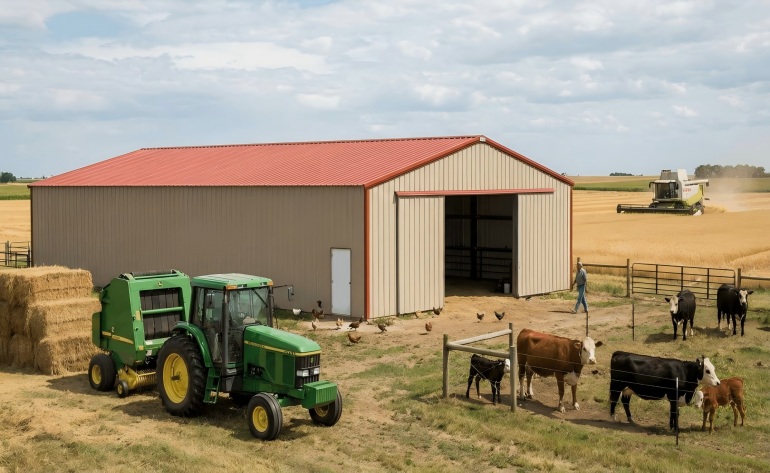
- Equipment sheds: Designed with high clearances and large bay doors to accommodate and protect expensive machinery, extending equipment service life.
- Livestock housing: Combined with partial enclosure and insulation to create a comfortable environment for animals year‑round, while also facilitating easy cleaning and biosecurity measures.
Conclusion
Against a backdrop of global trade dynamics and changing climate patterns, the resilience of agricultural infrastructure has never been more important.
Choosing a steel structure farm warehouse is ultimately a choice for efficient, safe, and sustainable operations. It is no longer just a place to store supplies—it becomes a vital part of the modern agricultural supply chain, giving farm owners greater confidence in navigating market fluctuations and environmental challenges.
If you are planning a farm expansion or upgrading your existing facilities, a steel structure system may be worth adding to your evaluation list.